Collider
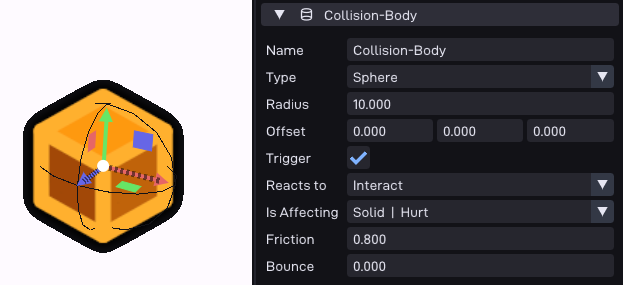
A primitive-shape collider attached to the object.
Unlike a Collision-Mesh this uses a simple analytic shape,
which is cheap and suitable for moving/dynamic objects.
Pair it with a Rigid-Body for full physics simulation.
Options
Option |
Description |
|---|---|
Type |
The collider shape: |
Shape size |
The dimensions for the chosen shape in meters, e.g. Half Size for a box, Radius for a sphere, or Radius plus Half Height for cylinders/capsules/cones. Scaled by the object’s scale. |
Offset |
Offset of the shape’s center relative to the object’s origin, in meters. Scaled by the object’s scale. |
Trigger |
When enabled, the collider reports overlaps as events but produces no physical (push-back) response. |
Reacts to |
The collision layers this body reads (which layers it collides with). |
Is Affecting |
The collision layers this body writes (which layers see it). |
Friction |
Surface friction, |
Bounce |
Restitution / bounciness, |
Changing a collider at runtime
Every value on this page is set on the collider itself, the component only creates it and registers it with the collision scene:
auto &coll = obj.getComponent<Comp::CollBody>()->collider;

auto halfExtend = coll.halfExtend();
halfExtend.y += 0.5f;                        // e.g. the half height of a cylinder/capsule/cone
coll.setHalfExtend(halfExtend);

coll.setCylinderShape(0.5f, 2.0f);           // size and shape type in one go
coll.setShapeType(Coll::ShapeType::Capsule); // keeps the size, folds it into the new shape
coll.setParentOffset({0.0f, 1.0f, 0.0f});    // moves the shape's center
Sizes and offsets are in the object’s local space, exactly like the values in the editor: the
object scale is applied on top of them and stays applied when the object is scaled later on.
The object-scaled result the collision detection runs on is read-only and named world...,
e.g. P64::Coll::Collider’s worldCylinderShape() or worldAabb().
setHalfExtend() works for every shape. Shapes that don’t use all three axes fold them in, e.g.
a cylinder takes its radius from max(x, z) and its half height from y, and a sphere takes its
radius from the largest component.
All setters keep the AABB (and with it the broadphase) plus the mass properties of an attached Rigid-Body in sync, and wake up sleeping bodies the change may touch. That is why the dimensions cannot be written directly.
See also
Collision & Physics: general collision & physics docs.
Rigid-Body: add physics simulation to a collider.
P64::Comp::CollBody: the runtime component in the C++ API.